
Musings

Weekly Musing: It. Has. Begun!

At the end of February I finished the initial draft of the historical fiction novel I’ve been researching for years. I’ve taken the last few months off away from it so it can sit and because I was mentally exhausted. During these last 4 months I worked on other stuff; mainly new short stories, jotting down new ideas, and accidentally starting another novel.

My self-imposed deadline to begin the revision process was July 1st. Well, as July 1st got closer, the more anxious I became. Excited, some, yes, but anxious because I know there is so much wrong with it. It is going to be an overwhelming amount of work just to get it to a coherent point.

Another cause for my anxiety was this is also going to be the first time I’ve tried revising a novel. Since I’ve never really revised a novel, I wasn’t sure where to start. On and off over the past 4 months I have thought about this process. Where to start? How long will this take me? And more than once, is this even worth it?

I chewed over the last question the most because the story is set during a little known rebellion that ultimately failed and how the ebb and flow of that rebellion is mirrored in the relationship between the two main characters. Because it’s not set in a popular time period or place I am concerned about if it is even worth revising since I suspect it will be a hard sell. Ultimately I realized that I need to continue the work on it. If I don’t I will regret it and even if I can’t get it traditionally published or decide to not even self-publish it, then I do need the practice on how to revise a novel.

Once that dilemma was decided, I focused more on trying to figure out what my process is for revising a novel. Writing is such a highly individualized sport that no matter how many books, articles, and interviews I read about revising, it still comes down to figuring out what works for me. I knew I simply couldn’t approach it as I would a short story due to my process for writing a short story is different from writing a novel. Thankfully I’m not under any kind of deadline so I can take my time.

The easiest part of the process was the day I printed out the manuscript. Apologies to the tree I probably killed to do it but hey, at least I recycle the paper. Since I hadn’t written it in order this meant I would have to cobble together in order the story. Messy but it’s how my brain works when drafting a novel.

Below is a picture of what it looked like when I put the book in order.

Organizing part 1
All laid out

Good thing I have a large expanse of floor space to lay things out. Since I need to visualize and touch things, I spent a couple of days staring at the finished product including reviewing scenes I was throwing out as well as noting scenes which still needed to be written.

What I happily discovered was by laying out the whole novel like I did was seeing each character’s presence in the story. It was also nice seeing the story falls into the classic 3 act structure.

Another problem I had to contend with was since I have two main characters who’s stories start off in different locations until they finally merge into one, how in the hell was I planning on ordering the story? Good for me I had written scenes down onto notecards with dates I worked on each scene. I connected the scenes together, dividing them into beginning, middle, and end. To solve the two main character question I further divided things by designating one column for each character and ordered things accordingly.

Compiling this proper like

Essentially I’m revising two novels which will be combined in the next round of revision. At this point, this makes sense to me and I think will allow me to completely immerse myself into each character’s mind and world.

Next came the very scary step of actually starting the revision stage. Below is a picture of what I’m referring to as my command center: the dining room table. While I have separate desks for my computer and physical writing, neither are big enough for me to spread out. Since I’ll be fact checking and doing additional research during this phase, I need my computer nearby. And who honestly uses their dining room table? We certainly don’t very often.
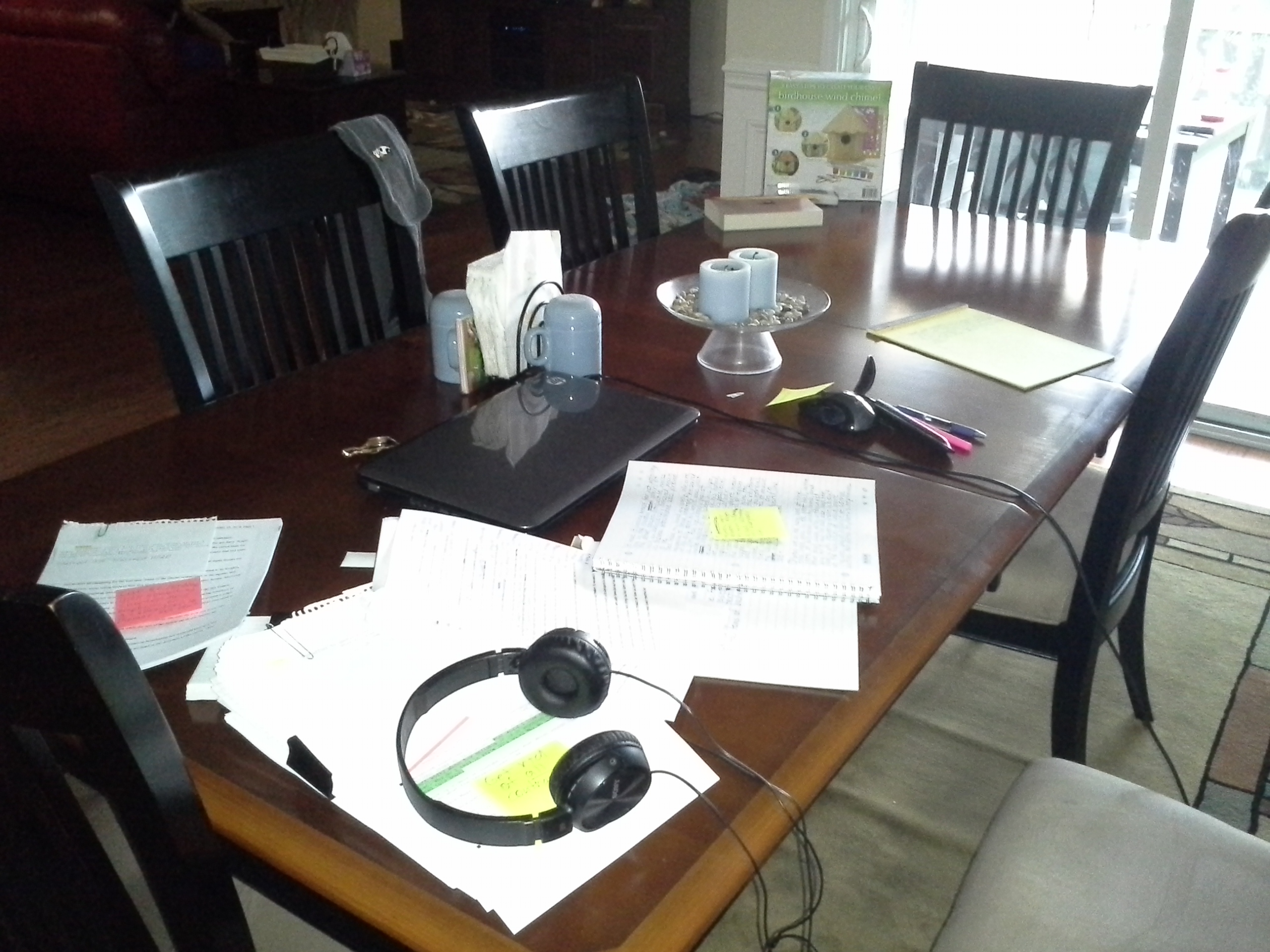
The bridge
The bridge

As of this writing, I’ve revised the opening chapter which took a lot longer than I anticipated. In the months ahead I know more research will be done, scenes will be added and deleted. The least of my concerns is the harder examination of the prose itself. Yes, I’m trying to rewrite some of the crap I threw down on paper but once I have my facts straightened out, I can relax and focus on that.

What I’ve been telling myself during this process is to keep in mind to take it word by word, sentence by sentence, page by page, chapter by chapter. This isn’t a sprint or even a marathon but an extreme marathon.

Musings

Weekly Musing: Free Speech

With today being the 4th of July I’ve been thinking a lot about freedom. In particular free speech, a topic that is dear to my heart not only as an American but as a writer as well. Free speech is always a hot button issue, but over the past few years the argument seems to be becoming more contentious. For some reason free speech to some seems to be about who is right vs. who is wrong. Yet this should be kept in mind: no matter how compassionate, empathetic, sympathetic of a person who think you are, someone out there will find you offensive. Good people offend people just as much as bad people do.

This musing is about what I see as vital to free speech for writers. We shouldn’t feel the need to hold back on language used in our prose. This does a huge disservice to both the story and the characters. Our characters are the ones who tell the story; we are just their vessel.

Yet something I’ve seen twice this week gave me great pause. On two separate days, two different authors asked within a Facebook group I’m in about usage of racial slurs in their manuscripts. One mentioned how her editor wanted her to substitute an historically accurate racial slur for something more politically correct. Many of us responded considering the place and time period of the story, if the word was what was commonly used, then it should be in the story regardless of how offensive it is. What disturbed me most was it was an editor advising the author to sanitize and make the story more in keeping with today’s sensibilities. It made me wonder if this editor had any prior experience with editing historical fiction or if the editor works for a publisher that doesn’t want to rock the boat or even perhaps the editor is allowing his or her own self to be offended rather than looking at the story as a whole.

Unfortunately, just a few days later there was yet another question posted by a different author about usage of racial slurs in their manuscript. This author expressed hesitation over including offensive terms and was curious to hear others’ thoughts. Overwhelming the response was again, if it is in keeping with the characters, the time period, and place, then yes, they must be included. Many advised against over usage especially in the narrative unless it’s first person. I responded that if people read the offensive term and aren’t offended then that says to me they’ve become de-sensitized to such language which is a far bigger issue.

Both of these dilemmas along with numerous online debates I see on a variety of topics regarding what is or isn’t offensive gets me thinking. Being offended by someone’s differing point of view, no matter how vile it is, is not a justification for censorship. With free speech comes the inherent right to be offended by someone else. This is completely and utterly okay. Two people do not agree 100% on everything all the time. Debate is great until it turns into an attempt to shame and guilt the other person. It’s also not the way to go about trying to change someone’s opinion.

When it comes to literature, the fictional world, like the real world, can be an ugly place full of people who say and do things that turn our stomachs and who have different morals and ethics from our own. So why the hell should literature be turned into a sanitized, unrealistic, and inaccurate version of life to appease the majority? And who is this majority? And why is the majority considered to be correct? And why does this mythical majority feel the need to squash stories about individuals, whether set in past, present, or future times, which are considered to be offensive? Our differences should be respected but that is not the same as agreeing with an opinion or action which we find offensive.

What I find the most offensive is when this real life need to suppress, shame, and guilt others dribbles down the literature pipeline. In our real lives we all know plenty of people whose views and experiences are so vastly different from our own that we legitimately wonder what the hell their problem is. We question how they came to what seems such an illogical conclusion. But one of the beautiful things about reading a wide-range of books is through others’ stories we can hope to learn the why behind such illogical actions. And if we are smart, we then apply those lessons to those we come across in our real lives, hopefully viewing them with a little more understanding.

We as writers should always remember to keep the story, characters, and language authentic no matter how repulsive it will be to some people. This isn’t to advocate for going overboard to shock and anger as many people as possible just for the hell of it. Ultimately the reader has the choice to close a book and move onto something that doesn’t offend them.

Musings

Weekly Musing: Remake, Reboot, Remix, Re-whatever

Over the last decade plus, there’s been an explosion of remakes and reboots. Sometimes the remake/reboot is a way of updating an older TV show or movie. Sometimes it’s a case of a successful franchise being rebooted probably just so the studio can make more money. Mostly it is at the movie theater where we see these but TV is starting to pick up the torch. In the 2015 – 2016 TV season there will be a limited run of The X-Files and Heroes Reborn will pop up on the schedule. There’s also been a smattering of bringing back shows for a limited run like 24 but by and large, TV has been safe from this remake/reboot fetish.

One of the biggest reasons why remakes/reboots are popular is there is built-in brand recognition. This is coupled with nostalgia you can see why remakes and reboots are big business. Look at how many TV shows and movies from the ’70s and ’80s have already been released or in the works. No matter how truly god awful these things are, still Hollywood makes them because studios make back the stupidly ridiculous amounts of money they spent. But the problem with using nostalgia as a business model is that most people view the past through rose-colored glasses.

This isn’t to say that no reboots/remakes should ever happen. Some have been incredibly well-written and well-received both on the small and big screen. 21 Jump Street was hilarious although it only vaguely resembled the TV show. The Batman franchise on both the small screen and big screen has been wildly success. And the granddaddy of them all, M*A*S*H is probably more well-known as a TV show first then as a movie even though the movie came out in 1970 based on a book that had come out 2 years prior.

So, just for fun, what shows would I like to see come back? Keep in mind this list is purely for fun as there is a huge part of me that would truly shudder if anyone actually decided these were a good idea. And yes, my list is based purely on nostalgia.

Punky Brewster: Oh, yes, this should come back. Although if this were updated, Punky would probably be from a different country, it wouldn’t be an elderly man as her adopted father, the dog would be some messed up breed like a Goldendoodle, and Punky’s awesome bed would disappear. The show would probably be ruined by bring in a love interest for Punky’s adoptive parent and then more focus would be on that rather than the relationship between Punky and her adopted parent.

Out of This World: I think I’m probably the only person from my generation who watched this show. It was quirky, odd, and science fiction which I didn’t realize at the time. Evie, the show’s man character, was part human, part alien and could freeze time. Who wouldn’t want that ability? Given how popular extra-ordinary people are this is one show that maybe could come back. Naturally I think the tone would change from gentle, family-friendly to dark, gritty, and Evie would suffer from way more angst due to dad never appearing here on Earth. Also, Evie would probably be written to kick ass and fight crime instead of just being sorta normal. On second thought, maybe this shouldn’t be remade.

Daria: This is one show I truly, desperately wished would come back. Daria Morgendorffer’s biting and highly accurate social commentary is much needed. I’d love to see her as a grown-up, though not necessarily with children of her own, can’t see her as a mother. Instead of being jaded by her fellow teenagers, she would be jaded by her fellow co-workers and neighbors. I also think Daria’s take on gender roles would be refreshing and rational rather than the emotional Social Justice Warrior crap that currently populates the internet.

I can’t honestly think of any other shows it would be fun to “what if” they were remade. By and large I prefer original ideas or quality book adaptions to just digging up what worked in the past. I guess when millions of dollars are on the line, it’s better to go with the safe bet even at the risk of fatiguing audiences.