Book Reviews

Scribbling Scrivener Reads: The Duke Don’t Dance by Richard G. Sharp

The Duke Don’t Dance by Richard G. Sharp spans more than fifty years following the lives of a group of friends representing the Silent Generation. The book opens with the funeral of Frank as the group is reunited for the first time in many years. But even though it’s a funeral and it’s been a long time since everyone has seen each other, the air is thick with tension as old wounds, rivalries, and loves (or flings really) come together. Beginning with chapter two, the rest of the book spends time recounting the long, varied, and chaotic history of these people while major historical events play on in the background.

The book doesn’t have one main character as each chapter head hops between at least two characters, sometimes more. While it’s Frank’s funeral which brings everyone together, he is not the main character although much of the early parts of the book features him more. Overall the book follows the lives of Frank, Lillian, Ted, Sam, and to lesser degrees, Inga and Beth. The relationships in the story quickly become convoluted with Frank having been married to Inga before divorcing and marrying Lillian who had had a fling with Ted and Sam who then in turn both had crushes on Ari who later uses Frank as her baby daddy. Throw in some other minor characters who are either married, had had some kind of relationship, or who pokes their nose into the personal lives of other characters, you get a confusing and messy set of “friendships” going on. And I use the term “friendship” loosely because honestly I have no idea when any of these people talk to each other let alone hang out.

The book doesn’t also center on anything I would consider an actual plot which makes it really hard to consider it a novel at all. The reality of it is The Duke Don’t Dance is a series of vignettes with the only connection being we are following a group of friends. Often times this group goes years without seeing or hearing from each other so then the reader gets another vignette to get us caught up with the lives of everyone else. Often times these vignettes felt like an opportunity to use a major historical event or time period to give the reader information rather than developing characters. There is no climax to the story and therefore no real resolution which again makes it difficult for me to consider it a novel.

This lack of a plot and a main character is one of several issues I had with the book as it felt very hard to refer to it as a novel despite involving fictional characters. Overall the biggest problem I had with The Duke Don’t Dance was the writing style. It’s all exposition and telling the reader rather than showing the reader who these people are. There’s also very little dialogue and when there is dialogue, it’s a scant few sentences that does nothing for the story or characters. The detached, head-hopping narrator style doesn’t really work for me as a reader as it was impossible for me to develop any kind of emotional attachment to anyone in the book. Even the historical events are treated in a detached way despite the fact the book spans the ’60s to 9/11. That’s an incredibly tumultuous time in American history with major events which have had long-lasting impact upon American culture even in 2016.

The characters themselves are hard to care about as they all sound the same. I think this is because of the narrative style which doesn’t allow for each character’s voice to come out. As a result, everyone sounds and thinks the same and with an ensemble this large, everyone starts blurring together. For example, up until the very end I had a hard time keeping Sam and Ted straight. It didn’t help that much of the time their stories intertwined and they both were half in love with the same woman from their college days.

I also found it difficult to relate to any of the characters because pretty much everyone is rather unlikeable. Everyone has their guard up and is so emotional stunted and angry for reasons not quite clear in some cases that it becomes incredibly taxing to the reader. Many times I wanted to tell these people to get over themselves and get into some therapy. All the women hate their mothers or are hated by their own daughters. Somehow the male characters with children were at least liked by their kids when we do see father and child together. It’s hard to believe all these people could be this monumentally messed up and I don’t think being part of the Silent Generation is the reason why.

Overall, this book simply didn’t work for me. At times the prose itself is quite lovely but when all of it is exposition and telling the reader then that gets overshadowed. I as a reader had I been shown who these characters are and formed my own opinion, I would have enjoyed a lot more. While I don’t shy away from large ensemble books, I think in the case of The Duke Don’t Dance it would have been better if the book had focused on two or three characters especially given the book is about 232 pages. It’s a lot to cram into such a short space with as many characters there are in the narrative.

On a scale of one to five pencils I give The Duke Don’t Dance two pencils.

Musings

Weekly Musing: Ding, Ding, Round Two is Over

Well, I am done with the second revision of my novel. Hooray! This will be the last post about it. It’s a relief getting it before the end of the month. This gives me a few days off to rest my mind before I start prepping for NaNoWriMo.

As before, here are some of the lessons I’ve learned going through the process of learning how to revise a novel.

Realistic Expectations for My Process: I’ve already promised myself that for round 3 I am going to allow myself about 6 months to get revisions done. All my deadlines have been self-imposed because without them I fear I won’t ever actually learn what my process is. It’s also a kick in the ass to get over my anxiety and get it done.

But I think the 4 month deadline isn’t very healthy for me. That’s why for round 3 I am going to give myself more time since it will be the first time I will be revising the story from point A to point Z instead of by character. I’ll be truly reading it as a reader would be reading it.

Plugging Plot Holes: While I think I’ve managed to plug up some of the plot holes, especially as I switched from one main character to the other, there are still many more. This is another reason why I’m going to give myself 6 months to get through the round of revisions. I’m sure I will be drafting new chapters unless I can figure out a way to convert what I’ve already written. Sooner I can get those holes filled in, the better. It is my goal that once I am done with the third pass, each revision after will be more in line with simply polishing the manuscript and getting feedback.

Realistic Expectations for the Manuscript: This ties in a little bit with plugging the plot holes. Right now the novel is still quite a mess. That’s okay. I finally feel like the time line is coming together as well as my understanding of the characters.

I realize that my chapters as they stand are far too long. I have numerous chapters which are over 2,500 words which may not sound too bad but when an overwhelming majority of the chapters are that length, reader fatigue should be considered especially nowadays. That being said, historical fiction books tend to be pretty lengthy and long chapters aren’t unusual.

On the other hand, it’s about the flow of the story. Will having long chapter after long chapter really serve the story? Can I get away with paring down several of the long chapters and still get the story across? What chapters can be sacrificed? Already I cut several from the rough draft. I also added in several scenes.

Looking back at the breakdown of words per character, one of the two main characters has about 20,000 more words than the other does. At this point I don’t feel this is a bad thing. I’ve never been shooting for a perfect 50/50 for the story, but is that balance fair to the story and the characters?

Research: It’s a bitch at times. I’m sure it will continue to be going into round 3. However I hope to continue to utilize cheat sheets of info. I think it will be great to do this for important historical events so I can quickly refer to what would be key to my story.

It amazes me how often I looked back in my books and previous research for more than just a simple line about a battle, for example, and not finding much. Or being able to nail down people’s movements after a major event. I have a hard time believing people just disappeared for a few months. You would think the books I have would contain such valuable information. Apparently not. And these are history books written by well-respected historians on this particular subject.

Or realizing that there are some seemingly easy questions I’ve asked but had problems finding the answers. A lot of hours spent on different websites to find these answers or cross-referencing answers only to discover conflicting information. That’s when I whipped out my privilege as a writer to go with my gut keeping in mind it is fiction first. If someone wants historical fact then read history books.

Playlists Don’t Help: Oddly enough, listening to music somewhat of the time period or which match with a mood didn’t actually help me. If anything it was a bigger distraction. Didn’t matter if it was playlist I created or someone else’s. Eventually I gave up and went back to listening to classical music or non-annoying electronica music.

Briefly, just a couple of stats of my book as it stands. So far I have 51 chapters for a total of 127,759 words. That is a lot of words but again, one of the beauties of historical fiction is longer is fine. That doesn’t mean I want to pad the pages with fluff. This is also down from the initial rough draft which was about 155,000 words.

I’m getting there and do think the second draft is pretty much the story I’ve struggled to get just right. Overall I’m hopeful for each revision from here on out. I don’t know if I think things will get easier. I want them to as I had no clue just how much work this was going to be. At times it was frustrating but ultimately, it is incredibly satisfying. Not sure when I will start again; not until 2016 and probably no sooner than February.


Musings

Weekly Musing: It. Has. Begun!

At the end of February I finished the initial draft of the historical fiction novel I’ve been researching for years. I’ve taken the last few months off away from it so it can sit and because I was mentally exhausted. During these last 4 months I worked on other stuff; mainly new short stories, jotting down new ideas, and accidentally starting another novel.

My self-imposed deadline to begin the revision process was July 1st. Well, as July 1st got closer, the more anxious I became. Excited, some, yes, but anxious because I know there is so much wrong with it. It is going to be an overwhelming amount of work just to get it to a coherent point.

Another cause for my anxiety was this is also going to be the first time I’ve tried revising a novel. Since I’ve never really revised a novel, I wasn’t sure where to start. On and off over the past 4 months I have thought about this process. Where to start? How long will this take me? And more than once, is this even worth it?

I chewed over the last question the most because the story is set during a little known rebellion that ultimately failed and how the ebb and flow of that rebellion is mirrored in the relationship between the two main characters. Because it’s not set in a popular time period or place I am concerned about if it is even worth revising since I suspect it will be a hard sell. Ultimately I realized that I need to continue the work on it. If I don’t I will regret it and even if I can’t get it traditionally published or decide to not even self-publish it, then I do need the practice on how to revise a novel.

Once that dilemma was decided, I focused more on trying to figure out what my process is for revising a novel. Writing is such a highly individualized sport that no matter how many books, articles, and interviews I read about revising, it still comes down to figuring out what works for me. I knew I simply couldn’t approach it as I would a short story due to my process for writing a short story is different from writing a novel. Thankfully I’m not under any kind of deadline so I can take my time.

The easiest part of the process was the day I printed out the manuscript. Apologies to the tree I probably killed to do it but hey, at least I recycle the paper. Since I hadn’t written it in order this meant I would have to cobble together in order the story. Messy but it’s how my brain works when drafting a novel.

Below is a picture of what it looked like when I put the book in order.

Organizing part 1
All laid out

Good thing I have a large expanse of floor space to lay things out. Since I need to visualize and touch things, I spent a couple of days staring at the finished product including reviewing scenes I was throwing out as well as noting scenes which still needed to be written.

What I happily discovered was by laying out the whole novel like I did was seeing each character’s presence in the story. It was also nice seeing the story falls into the classic 3 act structure.

Another problem I had to contend with was since I have two main characters who’s stories start off in different locations until they finally merge into one, how in the hell was I planning on ordering the story? Good for me I had written scenes down onto notecards with dates I worked on each scene. I connected the scenes together, dividing them into beginning, middle, and end. To solve the two main character question I further divided things by designating one column for each character and ordered things accordingly.

Compiling this proper like

Essentially I’m revising two novels which will be combined in the next round of revision. At this point, this makes sense to me and I think will allow me to completely immerse myself into each character’s mind and world.

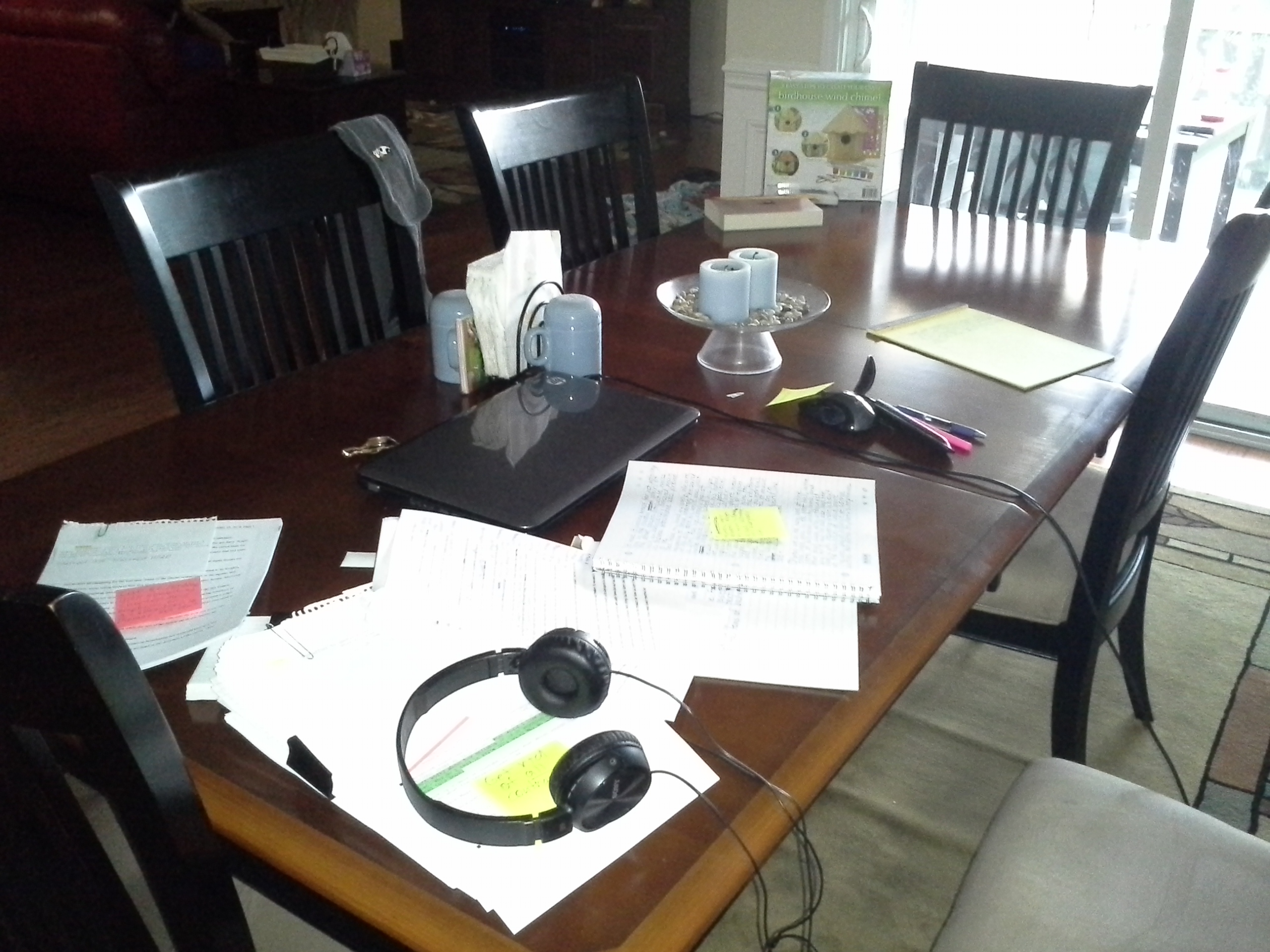
Next came the very scary step of actually starting the revision stage. Below is a picture of what I’m referring to as my command center: the dining room table. While I have separate desks for my computer and physical writing, neither are big enough for me to spread out. Since I’ll be fact checking and doing additional research during this phase, I need my computer nearby. And who honestly uses their dining room table? We certainly don’t very often.

The bridge
The bridge

As of this writing, I’ve revised the opening chapter which took a lot longer than I anticipated. In the months ahead I know more research will be done, scenes will be added and deleted. The least of my concerns is the harder examination of the prose itself. Yes, I’m trying to rewrite some of the crap I threw down on paper but once I have my facts straightened out, I can relax and focus on that.

What I’ve been telling myself during this process is to keep in mind to take it word by word, sentence by sentence, page by page, chapter by chapter. This isn’t a sprint or even a marathon but an extreme marathon.